Sadly, many of our colleagues in less-enlightened schools are asked to take responsibility for teaching a particular strand of the curriculum during their time with students, often in that time when they are covering teacher preparation and planning time. And while that can be a way to embed the information literacy skills that are an integral aspect of each strand of the Australian Curriculum, often the teaching and learning becomes a content-building exercise and tends to be limited to subjects like Science, Geography, History or Humanities and Social Sciences, or in some cases covers the broader elements of the General Capabilities and Cross-Curriculum Priorities and those Key Learning Areas become the stand that the hat is pinned on.
But what if we looked at some of the other strands, like Music for example? How can we cover the intended outcomes while enriching the students’ knowledge of and appreciation for literature, showing them that in real life some things have no artificial boundaries?
Yes, we can get students to research the lives of various musicians or investigate the instruments of the orchestra. But maybe there is a broader brush we can use. What if we took this poem by Bo Burnham and changed the last line to “Must be music!” And then got them involved in investigating how authors build the characters in their stories into credible beings that the reader cares enough about to want to read to the end of the story to see what happens to them.
Magic – Bo Burnham
In Prokofiev’s classic Peter and the Wolf, each character – Peter, his grandfather, the bird, the cat, the duck and the wolf, even the soldiers – is assigned an instrument of the orchestra which represents them as the story is told. For instance, the bird is portrayed by the jaunty music of the piccolo, while the deep, slow notes of the bassoon signal Grandpa. Using that as a starting point, why not have the students begin to look at characterisation in stories through a musical lens?
Take the poem and having become familiar with the sounds of the various instruments, what would they suggest as being the best to portray the shouting, the screaming, the whispering, or even the crotchety old man? How does the pitch, the tone, the speed and the volume of each instrument contribute to painting that visual picture through sound?
Share Roald Dahl’s description of The BFG walking down Sophie’s street, doing something suspicious at each window, or another piece of description about a familiar character. What sort of music would suit the action and what instrument would make it?
When they are reading about their favourite character what music do they hear in their head? If the story is about a giant or a dragon or a fairy, or a group of children sneaking through the bush, what instrument and type of music do they associate with each? Which characters that they already know would be best suited being represented by the violin, for example, and what would the music sound like? Fast, slow, soft, loud? Have them think about not just the size of the character and its other physical attributes, but the way it moves, even what its position and motive in the story are. Is it friendly or sinister? All can contribute to the choices.
Have them think about themselves and their own personalities and consider which instrument would best represent them> Is their one that fits all their moods or would it change with circumstance? Would there be a different choice for early in the morning and leaving a warm bed to go to school to that of the afternoon when it is play time or even later, tired and getting ready for bed? Even if the instrument remains the same, how does the music it makes change?
Conversely, play a piece of music such as “In the Hall of the Mountain King” from the music accompanying Peer Gynt by Edvard Grieg and have them suggest the sort of characters that they see in their mind’s eye just by listening. Does it suggest fairies and butterflies or something else? Can they draw what they are visualising?
Or maybe share some of the classic ballet suites such as “Swan Lake” or “The Nutcracker“. How has the composer distinguished between each character to make both an aural and visual picture? How has the choreographer translated this into a kinesthetic picture?
Then, take their developing knowledge even further and have each student select an instrument and build a character around it, creating a signature tune like those in Peter and the Wolf and then in groups of three or four, have them meld their characters into a cohesive story that can be told in both print and sound.
From this beginning, it is not a giant leap to comparing mood and music to build the story’s atmosphere… which instruments portray dark and gloomy, ominous and imminent, light and fancy-free? Have them listen to the musical scores of film or television shows to discover how the action and atmosphere is underscored by the piece of music that underpins it. Set them a task to select or even create the opening music to a favourite story so the reader has an idea of what is coming….
If we want our students to be both critical and creative readers, to engage with the story on a deeper level beyond the printed word or visual image they see, then this sort of approach not only does that but also satisfies a number of the outcomes of the music curriculum in a way that even the most non-musical like me can enjoy and appreciate – and makes such a change from the same-old, same-old that many students expect when it is time for “library”.
To Dewey or not to Dewey? Or even modify or simplify this scheme developed by American librarian Melvil Dewey in the late 19th century that is still used in libraries around the world today.
In an age where there is a belief that “everything is available on the internet” so non fiction print collections are being discarded at worst, and reduced at best, this is a question that has vexed teacher librarians, particularly, for some time. Even with the access to records that are already catalogued and just there to be downloaded through service like the Australian Schools Catalogue Information Service (SCIS) so that time that was spent on original cataloguing can be used for other essential tasks, there are still those who grapple with this issue.
There are some who feel that it is not a problem because their non fiction collections are so small that finding what is required is easy, but it bothers me that non fiction collections have shrunk so much particularly in the primary school. Others say that they have just completed post-grad tertiary studies and didn’t consult a print non fiction text once, perhaps forgetting that they had sophisticated search skills that littlies don’t, and one would have to question whether that is a reasonable reason to deprive students of access to their first source of information after asking their parents.
Some years ago, lead by publishers such as Dorling Kindersley and Usborne, the format of non fiction became much more user-friendly particularly for young readers, and today, publishers have this age group firmly in mind because they understand that
not everything is available on the internet
what is there is not necessarily aimed at the curious minds of the very young and so is not accessible to them
not all young readers have easy access to internet-enabled devices and don’t have the knowledge or skills to search for what they want
young readers get as much from looking at the illustrations as they do from reading the text and so an attractive, graphic-laden layout is essential
young readers like to look, think and return to the same topic or title over and over and the static nature of a print resource allows this
that not everyone prefers to read from a screen, that print is the preferred medium of many, and there is research that shows that many prefer to print onscreen articles so they can absorb them better
that research by people like Dr Barbara Combes shows that screen-reading and information -seeking on the internet requires a different set of skills and those most able are those with a strong foundation built on the traditional skills developed through print
young readers need support to navigate texts so they offer contents pages, indices, glossaries and a host of other cues and clues that allow and encourage the development of information literacy skills, and again, the static nature of a book enables the young reader to flip between pages more easily
the price of the book covers its cost and so there is no distracting eye-candy to distract the reader from their purpose and pursuit
the content of most non fiction books is designed to inform rather than persuade or challenge, and so the young reader doesn’t need to be searching for objectivity, bias and undercurrent messaging
that young children are innately curious and that exploring the answer to a question via a book with the child in charge is a unique bonding experience shared between parent and child that is not the same as looking at a webpage where the parent controls the mouse
that children know what they’re interested in and a range of resources gives them a range of options all at the same time; that one question leads to another and the answer might be in another resources on the same topic but with a slightly different slant
that children don’t know what they don’t know so browsing an interesting display of books with bright covers and intriguing titles can open gates to new pathways
And so, publishers continue to publish brilliant non fiction – over 500 have been reviewed on my blog in the past few years – and as much as I use the internet and have done since 1996, I believe we still have a responsibility to purchase, organise and offer a robust well-rounded non fiction collection to those who wish to use it, thus making its classification and notation critical if users are to find what they want efficiently and effectively.
For more whys. wherefores and ways to update and promote your NF collection , read this blog post from Madison’s Library.
There are some who want to or choose to genrify their non fiction collections, a concept that completely baffles me because IMO Dewey has already done this by putting like with like under his system and so beyond imploring TLs to ask and answer the questions in Questioning Change so they are clear on why they are doing it, the impact it will have, and the evidence for it can justify any challenges, that approach will not be discussed here.
But, even if we choose to use Dewey as the basis for the classification of the collection, there is a school of thought that suggests that we should only use the first three numbers with no decimals after it, particularly in a time of shrinking collections and in the primary setting. The reason commonly given for this change is that shelving is time-consuming and tedious especially when there is no paraprofessional assistance in the library.
So, once again, I find myself returning to the The 7 Habits of Highly Effective Peopleby Steven R. Covey, a book I was introduced to by an enlightened principal nearly 30 years ago and which has influenced me so greatly. In it, Covey suggests that we should “begin with the end in mind” so all the steps we take are in the right direction. So the basic question to be answered is
What do we want to achieve by organising the non fiction collection?
To me, there is one answer that stands above all others
to enable users of the collection to be able to locate the resources they need effectively and efficiently
Having established the why then we address the how and given the time restraints we all face, surely it makes sense to use a system that is not only used in more than 140 countries around the world, but one that is continually monitored and updated as required by the changing society we live in by OCLC (Online Computer Library Center) a global library organization which owns all copyright rights in the Dewey Decimal Classification, and licenses the system for a variety of uses. Although it was first published in 1876, it has undergone 23 hugely significant revisions, and each year changes to the core are made through “number building, interoperable translations, association with categorized content, and mappings to other subject schemes.” made accessible to subscribers through WebDewey so the updates are readily available. ( Introduction to the Dewey Decimal Classification, 2019)
Because the DDC is used so widely by such a variety of libraries and an even larger variety of patrons, its notation can become complex, overwhelming and even unwieldy in some circumstances, such as a primary school library. So, as the professionals in the field in the school, we must decide what is appropriate for those who use our collection and thus we return to our original question – What do we want to achieve by organising the non fiction collection? and its answer -“to enable users of the collection to be able to locate the resources they need effectively and efficiently”
In the article cited from OCLC, the following definitions are offered..
Classification provides a system for organizing knowledge. Classification may be used to organize knowledge represented in any form, e.g., books, documents, electronic resources.
Notation is the system of symbols used to represent the classes in a classification system.
It is the degree of notation that seems to be main sticking point for school libraries – how much is too much but how much is enough?
To me, as well as keeping the end in mind, we must also keep the students is mind because, ultimately, that’s who we are there for. So I offer these thoughts…
If students are to be independent, efficient and effective creators and users of ideas and information then we must offer them the means and the tools to be able to locate the resources that will support this, and initially, this means being able to find things in their own school library. Using a system that allows them to do this is common sense and teaching them how to use it properly is part of our specialist teaching remit.
Students are more likely to use what they understand, So while they don’t have to manipulate Dewey to the depth that they need to classify resources, understanding that each number has a meaning helps them realise there is a purpose to them and that purpose empowers them to use the system for themselves. Emphasisng that all they need to do is to be able to count in order from 0-999 is often all it takes for them to believe that they can master the system.
Click on this link below to access a slideshow that introduces the DDC to young users
Being empowered to find things independently not only gives the students confidence but also promotes the concept that the library is a place for them to visit, use and enjoy. There are not many things that an 8-year-old has control over and so to feel able to find what they want when they want it is powerful. So as both teachers and librarians we have a duty to support them in doing this.
Imagine being a young person who has just signed up to play for their first soccer team and you want to learn some of the basics of the game. You go to the library but instead of being able to find what you want immediately at 796.334 (because you already know how to use the OPAC) you are confronted by books about all sports, their guides, rules, and players and so forth, because they all have the same notation of 796. Are you likely to thumb through all of them to find the one that meets your needs, or are you like to turn to Google instead? And not bother with the library again?
Because that’s the reality if we choose to just use the main notation and not bother about decimal points.
It may make shelving less tedious and less time-consuming in the short-term, but how is it impacting the thought processes and research practices of the students in the long term? Do we just teach for the ‘now ‘and not for the ‘then’?
We cannot underestimate the power and the importance of students feeling comfortable and confident in using the space, and dumbing down the curriculum to suit ourselves is not an option, in my opinion.
In fact, I believe we should go as far as we can to support students in their independence so anyone using the library has the potential to find what they want for themselves, even if that is just generally browsing because browsing can lead to wanting to know more about a specific topic that will most likely have its place on the shelf. I liken it to being invited to a birthday party and being told that it is in Main Street, but without the specific address am I to knock on the door of every house in the street? Kids understand that analogy and they understand that each book has its own “address” on the shelves.
When, in 1996, after 26 years as a classroom teacher. life circumstances compelled me to make a switch to being a teacher librarian, I met the preschool daughter of a colleague, now BFF. Molly had just been diagnosed with severe, life-threatening epilepsy which resulted in significant learning difficulties. But all she wanted to do was come to school and be in the library. And so, inspired by her, I vowed that the brand new school library I was establishing would provide physical and intellectual access to all, enshrining my belief that the library was for everyone and my intention to make it so in our mission statement.
Thus, as well as teaching those who were able how to use the OPAC and the Dewey system in tandem, we created signage that meant that even Molly and her friends in the special ed unit could find the books about the things that interested them. Using cheap, lightweight objects, commercial index blocks and MS Publisher we created a variety of signs that matched our library and our students’ needs. Molly was in heaven!
As well, we introduced a program that encouraged students to become shelf-angels. They took responsibility for taking care of a shelf to ensure that resources on it were in the correct order, and before long, they were scouring the returns trolley to see if there were any books to be returned to “their” shelf. Every now and then we would do random checks and little shelf-angel certificates were awarded to those whose shelves met the standard. Given these were accompanied by other library-based privileges, they were well sought-after.
And those that were the most proficient? Those in Year 3 who were so proud of being able to show they could count to 999, make a contribution to school life, show their parents their prowess and feel ownership of the facility.
So if you are one who is contemplating “ditching the decimal”, as with any major change to the way the library operates now and into the future, read, ask and answer the questions posed in Questioning Change and consider the short and long-term impact of your decision.
In the meantime, Order in the Library has been a very popular shelving game for many years. And NSW teacher librarian Louise Mashiah recently shared this new game she created for her youngest students and which has become a favourite, even during breaks., and which she has given me permission to share.
I painted some ‘bookshelves’ onto calico and added some Velcro. Printed ‘books’ onto iron on transfer paper and also put onto calico with Velcro on the back. Made some shelf labels that I could change to use for non fiction at a later date. Kids loved finding and shelving the books in the correct place.
Over the past couple of weeks there have been two significant events in school libraries in Australia – the start of the school year and Library Lovers’ Day. And because the two can be linked directly, they present great teaching opportunities that can be solidly supported by outcomes from the Australian Curriculum, thus underpinning the Educate-Advocate Hat.
From conversations on several TL networks, it seems that many TLs use the first weeks of the school year to set the rules for the library. Rules which pertain to behaviour, circulation, the care of the resources and the other things required to have a smooth operation.
From other conversations on those same networks, to celebrate Library Lovers’ Day on February 14, many also asked their staff and students what they loved about their library, seeking affirmation of the role they do and the environment they provide. A common theme emerged from those heart-shaped affirmations – that of the library being a calm, peaceful safe harbour.
So, what if we combined those two concepts and started by asking the students what a safe harbour looks like to them?
If, as Stephen Covey suggests in The 7 Habits of Highly Effective People, we begin with “the end in mind”, and start with the premise that the library is seen as a safe haven and then work back from that to establish the behavioural expectations and personal responsibilities that would make it what everyone seems to want it? So that the “rules” are not imposed by an authority figure but developed co-operatively and collaboratively by those expected to follow them?
Under the self-management element of the Personal and Social Capability strand of the Australian Curriculum V9 , even foundation students are required to “co-create goals to assist learning when working independently or collaboratively” and so, such an approach can be the start of being able to do this.
Many TLs are showing classes the Bluey episode (ABC iview, Season 2, Episode 30) in which Bluey and Bingo are playing “library” together until their cousin Muffin arrives and causes chaos, thus offering an opening big-picture question of “Why do we need rules?” This, in turn, will help students understand that if there is to be a safe haven then there needs to be certain consistencies to ensure that things work for everyone. Having established the need for some rules, the discussion can then move to more specific questions relating to the sorts of things students expect to be able to do in the library, and then their suggestions for the sort of behaviours that will enable those things to happen. For example, they might say, “We like to read quietly.” So ask them how they could make sure this could happen. However, instead of accepting “Don’t talk”, have them express this in a way that reinforces the positive behaviour expected – “Use a quiet voice when you speak.”
While older students will be familiar with the school’s behavioural expectations and thus be able to frame and phrase those they want for the library, younger students will still be learning so it can be useful to use an “intermediary” such as Dr Booklove so the TL is not seen as yet another authority figure looming over them. Asking an errant child, “What would Dr Booklove like to see?” can often defuse situations because it puts the behaviour and its response into the third person.
Having established the expectations for general behaviour, this can then be extended to book care and circulation with the emphasis being on the individual student’s responsibility to others so that they can demonstrate both their social awareness and social management. Even older students can see that Muffin’s taking all the books means Bluey and Bingo miss out.
Although this approach will lead to different standards for the different age groups, this should be expected given the different levels of maturity and experience, (reflected in the AC outcomes) and is worthwhile because students are more likely to respect rules that they have had a hand in forming. And instead of becoming a ho-hum-here-we-go-again lesson for students to tune out of, by explicitly acknowledging their developing maturity and expected ability to develop self and group management skills, the TL is building relationships that will have deeper repercussions in the future as the students’ attitude towards the library as a positive place is reinforced. They will see it as the safe haven for learning and leisure that they desire, In addition, the TL can put on the educate-advocate hat as lesson plans are directly linked to outcomes that go beyond basic literacy development. Seems like win-win to me.
Sadly, there are still many teachers and PTB who view the teacher librarian’s role as the reading expert and the keeper of the books. Despite all the years of advocacy – something no other professional has to do to justify their daily existence – those in high places (including government, education authorities and schools) are yet to learn that there is a reason that to be a teacher librarian entails a post-graduate qualification, involves specialist knowledge and is so much more than their childhood recollections of a place filled with books.
The key issue seems to be a lack of understanding of the role of the modern TL in the support of teaching and learning stemming from the days of the introduction of affordable, reliable internet access and the mistaken belief that “everything can be found on the internet” coupled with the perpetuated myth that the TL’s main role is to do with reading and the circulation of books. As I have said so many times in the past 25+ years as a TL (and 53 as a teacher) TLs are NOT “English teachers on steroids” yet so many continue to present themselves as such. While we have a role in supporting the leisure reading of our students , our primary role is enabling them to navigate, and evaluate information in all its formats, and then interpreting this to form their own viewpoints, inform their choices and create new information. Thus, despite over 30 years of trying to change perceptions, including a Federal Inquiry into our role here in Australia, the fight continues and we must do all that we can, including sharing planning that puts the emphasis on that primary information literacy role to show what it is we can do. IMO, as long as we continue to put reading and books as the primary focus we will always be seen as the “keeper of the books” by those who hole the purse strings and fewer and fewer teachers and students will experience the benefits that a fully0informed, qualified TL can bring to the table.
So now, at the beginning of the school year when we are planning what students will do during their time with us, we have the best opportunity to use our programming skills to show how we can contribute to both the teaching and learning outcomes of the school in a purposeful, meaningful and wide-reaching way. To educate and advocate.
Recently, a NSW colleague Emily G. Williams generously shared her Term 1 program for her year 3-4 students with a wider audience so others could have a starting point for theirs. With Emily’s permission, this is what she offered…
OVERVIEW: The beginning of the term will be spent refamiliarising ourselves with the library, its contents, expectations and borrowing needs. Students will participate in a QR code scavenger hunt for library orientation. The rest of the term students will be engaged in picture books from the Premier’s Reading Challenge based on Australian environments (to support their classroom unit Earth’s Environment). Students will write a book review for each and add to their PRC profile.
Outcomes:
EN2-4A uses an increasing range of skills, strategies and knowledge to fluently read, view and comprehend a range of texts on increasingly challenging topics in different media and technologies
ENe2=7B understand how characters, actions and events in imaginative texts can engage the reader.
Library Outcomes
LK4.3 Metalanguage of the library – call number, shelf label, OPAC, Oliver, Dewey, circulation desk, return tray or slot, reference, etc..
LK4:15 Selects appropriate text based on purpose, interest and ability. Recognises the benefits of selecting from a wide range of texts
LK4:18 Uses LMS (OLIVER) to locate fiction resources by author and places reservations. Use OLIVER to write and record a book review
LL4:1 Completes a short-written review on a chapter book
LL4:23 Explain the contribution of illustrations in developing the sequence of main events and climax of a particular fiction book
Information Fluency Framework
IFF2S.1.1 identify and describe shared perspectives within and across various cultural groups
IFF2L.1.1 navigate, read and view a range of texts for information purposes or literary exploration.
IFF2L.1.2 interpret literal information / story and make inferences to expand knowledge or understanding of the story
IFF2I.2.2 experiment with a range of options when putting ideas into action
IFF2C.2.3 transfer and apply information in one setting to enrich another
IFF2E.2.1 apply ethical decisions when creating information
But what if we changed this outline to place greater emphasis on the purpose of the program by identifying what we want students to know, do, understand, appreciate and value as a result of the time invested, and the evidence we would accept that they had achieved this? Could we get something that, apart from making our own teaching purpose clearer, would show others that what we teach has meaning, context and validity beyond the library’s walls thus helping them to change their perception of our role?
Perhaps the new plan could look something like this…
OVERVIEW/PURPOSE
As students become more aware of the world around them, they are presented with a variety of viewpoints from which they are increasingly expected to form their own opinions, make informed choices, create new information and take targeted action. Yet the messages students see and hear through an increasingly complex media landscape can be conflicting and confusing. Therefore, they need to become critical assessors of these so they can identify the author’s objectivity or lack of it and evaluate the information in light of this. This program is designed to build their awareness of the influence a writer’s perspective has on their writing and enable them to examine texts for purpose and bias.
To complement the classroom study of Earth’s Environment, students will use picture books, particularly those on the Stage 2 PRC list which focus on the Australian environment, so they can
understand and appreciate that authors write for a purpose – to persuade, inform, entertain or reflect
identify and distinguish between fiction, fact and opinion
examine and explore a text to determine the author’s purpose
understand that there can be differing points of view about the same situation
understand and appreciate that authors use fiction and narrative non fiction to convey a message, perspective or particular point of view
identify the text features and language of persuasion
use their existing knowledge of the library’s layout, language and systems to locate and select an appropriate text to study, seeking assistance if required
identify what a particular author’s perspective is and how it has influenced their writing
identify how the author has used the setting, characters and plot to convey/portray/embed their message
identify how the illustrations have been used to consolidate the author’s message through the medium, colour palette, perspective and other devices
consider their own perspective and opinion about a particular issue and whether the author has confirmed, challenged or changed their point of view
transfer what they have learned by using books focusing on the Australian environment to those featuring a broader scope so they can compare the similarities and differences of a variety of environmental situations and issues
understand and use the essential elements of a book review as they write their own to demonstrate their understanding of the concepts of assessing texts for suitability and interpreting them for objectivity, including providing evidence to support their opinion
navigate and use the functionality of Oliver to publish their review
extend their reading into new areas and add to their personal Premier’s Reading Challenge records
EVIDENCE
Students will select a book with an Australian environmental focus and prepare a book review for publication on Oliver that demonstrates that they understand the author’s purpose and message and explains how this has been achieved.
LEARNING OUTCOMES
As a result of this study students will demonstrate the following outcomes*…
pose questions to expand their knowledge about the world (ACC General capabilities –Critical and Creative Thinking L3)
identify main ideas and select and clarify information from a range of sources (ACC General capabilities – Critical and Creative Thinking L3)
collect, compare and categorise facts and opinions found in a widening range of sources (ACC General capabilities – Critical and Creative Thinking L3)
identify and apply appropriate reasoning and thinking strategies for particular outcomes (ACC General capabilities – Critical and Creative Thinking L3)
draw on prior knowledge and use evidence when choosing a course of action or drawing a conclusion (ACC General capabilities – Critical and Creative Thinking L3)
explain and justify ideas and outcomes (ACC General capabilities – Critical and Creative Thinking )
transfer and apply information in one setting to enrich another (ACC General capabilities – Critical and Creative Thinking )
discuss the value of diverse perspectives and describe a point of view that is different from their own (ACC General capabilities –Personal and Social Capability)
describe different points of view associated with an ethical dilemma and give possible reasons for these differences ACC General capabilities – Ethical Understanding)
make connections between the ways different authors may represent similar storylines, ideas and relationships (ACELT1602)
discuss literary experiences with others, sharing responses and expressing a point of view (ACELT1603)
identify characteristic features used in imaginative, informative and persuasive texts to meet the purpose of the text (ACELY1690)
use comprehension strategies to build literal and inferred meaning to expand content knowledge, integrating and linking ideas and analysing and evaluating texts (ACELY 1692)
plan, draft and publish imaginative, informative and persuasive texts containing key information and supporting details for a widening range of audiences, demonstrating increasing control over text structures and language features (ACELY1694)
re-read and edit for meaning by adding, deleting or moving words or word groups to improve content and structure (ACELY 1695)
use a range of software including word processing programs to construct, edit and publish written text, and select, edit and place visual, print and audio elements (ACELY 1697)
understand differences between the language of opinion and feeling and the language of factual reporting or recording (ACELA 1689)
understand how texts vary in complexity and technicality depending on the approach to the topic, the purpose and the intended audience (ACELA 1490)
explore the effect of choices when framing an image, placement of elements in the image, and salience on composition of still and moving images in a range of types of texts (ACELA 1496)
*For the sake of inclusion for the majority of readers of this blog, outcomes have been taken from the Australian Curriculum. They could be supported or supplemented by specific outcomes from state and school-based curricula as required (and demonstrated in the original), thus illustrating how particular skills such as using the OPAC to locate resources support the student’s overall information literacy development, or engaging with the Premier’s Reading Challenge broadens their reading horizons.
By making the big-picture, lifelong learning outcomes the focus of the program – in this case, helping students begin to understand author purpose and detect bias and prejudice in writing, enabling them to be more creators and critical consumers of text in all its forms – and clearly stating these and their connections to other areas of the curriculum, we demonstrate that what is offered during “library lessons” not only supports the classroom program but shows that those skills usually seen as “bizniz-bilong-library” have both a purpose and a pathway that goes beyond its walls. Suddenly teachers have the evidence of what we intend to do and why in front of them in professional but accessible language. They can see that what we offer is valid and validated and perhaps even valuable. This could be taken even further by using a summary of the overview as the statement of learning for student reports, showing parents that the library is so much more than borrowing books and whatever their personal recollections are.
If we are to spend our precious time on this sort of paperwork, then it’s worth getting the biggest bang for our buck by educating those who need to know and advocating for a qualified teacher librarian who has essential knowledge and skills beyond that of the regular classroom teacher-that by working together we can offer so much more depth rather than being just that keeper of the books.
As children of the 50s my brother and I knew what a safe harbour meant, literally.
Growing up in a small port town, we would roam the beaches, the rocks and the wharves until the tide or the weather turned or it got dark. The chances of us getting into strife were minimal as all the while we were supervised by invisible eyes all of which knew us and our parents and grandparents.
I was Queen of all I could see….
But times have moved on and not all children have that same carefree childhood. Too many students have so many impediments in their lives that the routine of going to school is their one security, although sadly for a number it is school itself that is the impediment.
Across the globe and the generations libraries have been a safe haven for those in need, and the school library is no different, How many stories do we hear in which the teller refers to seeking sanctuary in the library during breaks in the school day? How many times does a teacher librarian state that the library’s role as a safe harbour is one of its key functions?
However, is it enough to offer just a safe physical environment for those seeking refuge, or is there more we can do to reach out to these students?
the invisibility cloak
Many students try to be invisible at school. If they blend into the background then perhaps the tormentors and the demons won’t find them and they can be safe for a little while.
But being invisible is not a natural part of the human condition. In a recent hospital stay, as sick as I was, I still found a natural need to be more than someone’s case study, more than the patient in Bed 2, more than another face on a pillow, or body in a bed. Even though I had something rare and life-threatening, I needed to be Barbara, a unique individual who had something to say and something to offer. So I found myself telling people that I had been a teacher for 50 years; that I lived in the peace of the bush and the noise and busyness of the city hospital was overwhelming; that my mum was a pioneer for female journalists… anything that might strike up a conversation and a relationship that took me beyond invisibility and anonymity.
And so it needs to be with those who choose the library as their safe place, because our self-esteem and self-worth are inextricably entwined with our sense of belonging, the belief that we matter to others and their perception of us (or what we believe it to be.) So, even some thing as simple as saying, “Good morning, Jemima” (where knowing and using the student’s name is critical) has a sub-text that tells Jemima that
she is worthy enough for you to acknowledge her presence
she matters enough to you that you have made an effort to recognise her, know her name and use it
her struggles are recognised and you have acknowledged her courage in coming to school today even though that might have been very difficult for her
That, in itself, might be the reason she comes to school again tomorrow.
going further
Being the teacher librarian can be an isolated role making it tricky to form the essential relationships that are necessary for optimum learning, and often we are not included when the stories of students are shared around the conference table with teachers and counsellors. But I maintain we should step forward and put ourselves in the stories of those who are the regulars seeking that lunchtime bolthole because we might just have the key that unlocks a whole lot of potential.
First stop is the student’s primary teacher, the one who has the pastoral care because they are most likely to know the back story and be able to give you an insight into the child’s likes, interests, and preferences. For example, some students can’t cope with public praise but may respond to a quiet word; some may have a specific talent such as art that you could draw on for improving the library landscape; some may have a specific interest in a field that you expand and explore together; some may be computer wizards that you can capitalise on; some may like to help the younger ones find what they are looking for; some may be craving a bit of responsibility and respect… each of us has something to offer if only someone would take the time to discover it and draw it from us.
Armed with this knowledge and that of your own observations, consider how you can subtly include the student in the running of the library or helping others or meeting new friends. Perhaps the computer person could be responsible for ensuring the computers are back to the login screen at the end of the session; the fantasy fan could make a list of “If you liked…then try…”; the artist could revamp signs and displays; the budding archaeologist could develop a display; the music fan might develop a playlist of background music; the Minecraft expert might help up-and-comers; the OCD student might keep the shelves in order and neat – whatever might acknowledge their talents and interests and put them to positive use. Apart from reinforcing their knowledge that you have taken the time to find out about them as an individual and taken the first steps in building a connection, often the distraction might be that day’s circuit breaker that puts a happy memory in the bank for the day.
It could even be a turning point, as it was for two lads in Year 5 who did not have the most positive reputation among staff or students until I put them in charge of a project for charity. We were collecting gifts for children whose families were so badly affected by drought there was little likelihood of Christmas that year. The change in the boys when they were entrusted with some responsibility was remarkable and not only within themselves, but also in the eyes of the other students. What had been shaping up to be a tricky Year 6 turned into being the best year for them and their peers as the goodwill was carried over.
Similarly for Ava, a student struggling with literacy and forming relationships. We talked about how she could cover an ugly, empty space with a display of her choice and her choice so excited her that her grandmother and I had many conversations about how she was driven at home to make it better and better and suddenly literacy wasn’t a problem any more. Her teacher was astonished that somehow we had found the hook and she was off.
As teacher librarians we are not psychologists or counsellors and we should not expect that we will solve the student’s issues. But if we accept Glasser’s Choice Theory that the choices we make are in response to satisfying one of the five basic needs – survival, love and belonging, power, freedom and fun – using what we have at that point in time with the information available to us, then through observation and conversation we might just make the connection that means the student will come to school tomorrow feeling better than they did today. They will know they are neither invisible or anonymous, they belong and can contribute, they have unique knowledge and skills that can help others, and there is hope that things will move forward.
What does your first week of “library lessons” look like?
Have you programmed the usual round of sessions where students are reminded of where to find things, how to borrow them, how to look after them and how to behave? Another barrage of I-talk-you-listen Another barrage of white noise that confirms their belief that the library is a place for downtime for them?
Or have you planned something to stimulate their thinking and reflecting on what they know, where they talk and you listen and together you build an anticipation and excitement for the year ahead?
Thirty years ago, in Mathematics Education for a Changing World,, Stephen S. Willoughby identified that by Year 6 what was taught to students was 38% new and 62% was revision of what was already known and it was not until Year 9 that the “new” outweighed the known. This raises serious issues about motivation, attention levels and zest for learning. So if for six years or more, students come to the library in that first week and hear what they have always heard, then they will do what they always do – tune out, see little value in the library and what it offers, and join the majority of students who, Miller discovered, saw reading anything as just an imposed means to an end.
Yet those first sessions could be so much more. They could be an opportunity to build the platform for the rest of the year so that library time, particularly if it covers teacher preparation time, becomes meaningful, dynamic, productive and anticipated.
In the series All You Need to Teach Information Literacy that Macmillan Education commissioned me to write some years ago, I started each year level’s units with one that focused on the students reflecting on what they already knew about libraries to encourage both students and the teacher librarian to consider what still needed to be learned and to build their programs on that.
By using opened-ended questions and whatever format suits the age group (class discussion; think, pair share; individual written responses) students can identify and share their knowledge and understandings so the TL can ensure that their forthcoming learning was new, challenging and productive.
For ease of organisation, I’ve sorted the focus questions into year levels but they are designed to be mixed and matched according to circumstances (and avoid repetition)..
Kindergarten
What is a library?
Who can use the library?
What sorts of things can you find there?
What sorts of things can you do there?
Who is there to help you?
Year 1
What is your favourite part of the library?
Can you usually find what you are looking for?
If you wanted a book about … where would you find it?
Do you understand why some things are found here and others there?
How do you borrow something you want to take home?
How do you look after it when it is at home?
Is borrowing a book the only thing you can do in this library?
Year 2
What do you know about our school library?
What do you think new students would need to know about it?
How could you help them learn about this library?
Year 3
Why is the library the hub of the school community?
How do you use the library for learning? For recreation?
Once you have selected a fiction title, how do you find others by the same author or others in the series?
Once you have selected a non fiction title, are you able to navigate it so you find the information you want easily and quickly?
What could you do to make the library a better place?
Year 4
Why do we have libraries?
How are libraries organised so you can find what you want efficiently and effectively?
Why are they organised this way?
What services, apart from the circulation of resources, does this library offer?
Which do you use?
What else would you like to see offered?
Year 5
How can you use what you know about this library to help others use it?
How can you use what you know about this library to enable you to use other libraries?
If you have a need for information, do you have a sequence of steps you can follow to solve it?
Which ones are you comfortable with; which ones do you need support with?
Year 6
If your teacher sets you a research assignment, do you feel that you can undertake it successfully, even if you feel a bit nervous at the beginning?
What sequence of steps would you take?
Why is being able to do research important?
Why is being able to use a library efficiently and effectively important?
How could you help another student use the library and its resources to complete a research assignment?
An analysis of students’ responses, including examining what is NOT said as much as what is, can help you shape the focus of your program with lessons only limited by your imagination.
For example, little ones respond to stories in which toys, teddies and animals are placed in situations with which they are familiar so why not introduce a teddy or two to be the ‘new student” that they have to teach. It puts them in the teaching role which is always powerful, the teddy in the role of the learner, and enables those who may be new or unsure to avoid the direct spotlight, often one which marginalises them. Even Kindy Kids can be authors with the tried-and-true strategy of experience, photograph and caption growing to a class book to share. (The pride in taking it home and showing parents their page was tangible!)
Brinda and Bella, dressed in school uniform, were used to introduce and review library places and procedures. Each year a new teddy joined the Kindergarten class and accompanied them through to Year 6!
At the other end of the scale, senior students were appointed Junior Journalists. Each trio chose a role of reporter, photographer or editor (which rotated with new assignments) and were assigned a school-based event, person or location to investigate and prepare a report for the school website so visitors to the site could get a deeper feel for the school. As well as gathering and preparing the information, they were required to document both their steps and feelings from beginning to end and many were reassured to discover that they were not the only ones who initially felt daunted and nervous at the start but liked the feeling of success and pride of the finished result. Being published in such an open forum also meant they had to be accurate and write carefully, and they could share their work beyond the family, a subtle way to showcase the work done in the library.
The Building Services Officer had a new-fangled GPS device so as part of a unit investigating the history and geography of the local area, Year 6 asked him how it worked. They learned a lot about latitude, longitude, maps and how to use them in a meaningful context as their work became an integral part of introducing the school to the public via the website.
Meanwhile, inspired by this clip, students in the middle years were tasked with developing a glossary that explained how to use the cues and clues of both print and digital texts so they could navigate them easily and readily. They began with examining lots of texts for their assigned focus – contents, captions, headings, subtitles and so forth – and had to produce a definition of it. Combined, these became a go-to reference point for others. Again, putting them in the role of the teacher is powerful and empowering and ensures student-directed learning and a differentiated cussiculum.
Another character that students loved was Dr Booklove, who was essentially in charge of the library. In the first week little ones worked “with” him to create some guidelines for looking after the things they borrowed from the library and not only were these displayed as a large poster, they designed a bookmark with the list on the back to be given to every student to help them remember what was needed. So even Kindy students became teachers. Older students also worked with him to determine what an orderly productive library time looked like when their class was there so both rules and consequences were collaborative, negotiated and age-appropriate.
Dr Booklove
The more learners are put in charge of their learning, the more invested and empowered they will feel; the more responsibility they are given, the more responsible they will be. So, having used their responses to identify gaps in their knowledge of library use and the information literacy process, look for ways in which they can become the teachers so whatever outcome you are seeking becomes not only an integral part of the learning but is embedded in a meaningful context which has purpose and allows them to transfer their new skills to new situations.
Apart from the increased engagement by the students in a model where they are the driver of their own learning, such an approach differentiates the curriculum allowing each to work at their own level of understanding. Usually, some well-considered questions that address what you want them to eventually know, do, understand and value to initiate thinking are all that is required for the investigation to develop its own momentum, opening the doors to self-directed learning that really needs a minimum of formal planning by the TL.
The first week sets the tone of what will follow for the year. It can either be Ho Hum or WooHoo.
Your TL degree is so new and shiny that the dust hasn’t had time to settle on its frame yet, but in a few short weeks you are going to be stepping into your dream job – the one you’ve been thinking of for years and have undertaken hundreds of hours of gruelling study to achieve.
Yet even though you might have excelled in your assignments and learned that being a TL is so much more than being a reading expert and circulating books, where you once thought you had this thing mastered, suddenly your brain is empty and you’re wondering where on earth you start. There just seems so much to do, and that you want to do but where to begin?
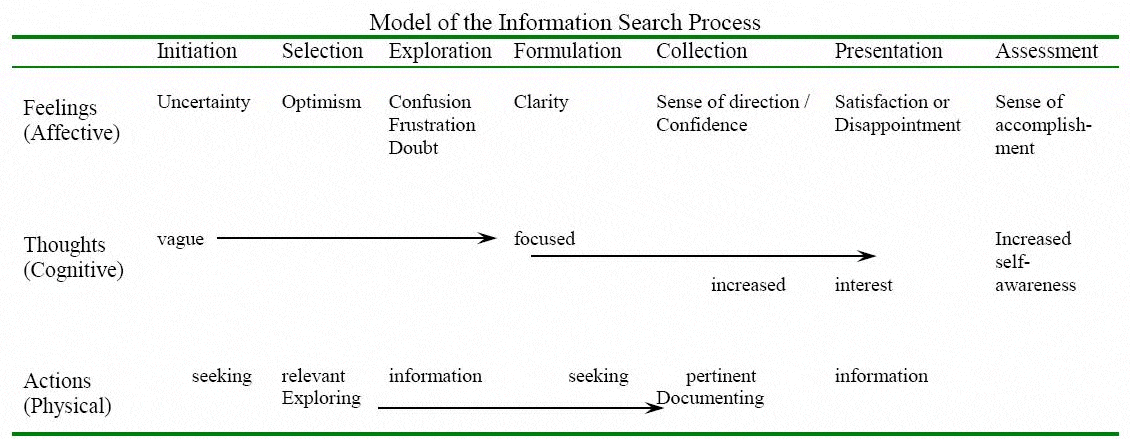
Firstly, go back to your initial learning about information literacy and recall the work of Carol Kuhlthau who examined the affective domain of taking on a new research task. (If you’re not familiar with her work, then that should be your first professional learning task because it will give you great insight into how students feel and respond.) Understand and accept that the feelings of being uncertain and overwhelmed are natural and common, take a deep breath and be kind to yourself.
Information Search Process
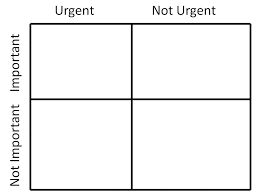
One of the reasons that we do feel as though we’ve just hit a wall is because we have so many ideas that the starting point is not clear. This is the time for clarity of thought and action and the best way is to break the task down into immediate, short, mid and long term goals. Time management is critical and Stephen Covey’s Habit 3 of putting first things first is a very useful mantra., as is his matrix for managing tasks.
Time Management Quadrant
Learn to ask yourself these questions…
Does this need to be done now or can it wait?
Is it more important than what I am doing right now?
If I don’t do it now, will that have an impact on other tasks that must be done?
Is it more important that the other things I have planned for today?
Will doing this help me achieve what needs to be done in the short, medium and long-term?
Does it require my time and attention or can I delegate?
If it helps, document the tasks you need to do and the ones you want to do so you don’t forget and when it comes time to develop a strategic plan to develop and manage the library’s growth all those big ideas are not forgotten or overlooked.
But first things first… what is it that needs to be in place before the first staff and students come through the door on Day 1?
There are two different scenarios – are you moving into an established library or are you starting a brand new one – but the tasks merge very quickly. If it is an established library, see if there has been anything left for you from the previous TL; if it is a new library then you have a clean slate and will have a little more to do. But the focus is the same – having a facility that is up and running efficiently as soon as possible.
people
Relationships are the most critical part of the job and the impression you make first up will be the lasting one, and could quite well determine how the library is used long term. So…
meet the current library staff and ask them about their current roles and responsibilities, timetable and other pertinent information including their aspirations. So often in situations where you are new and they are not, situations arise where those who have become used to doing things in a particular way cling to those ways, perhaps as security, and toxic relationships build. Perhaps have a general chat over a cuppa to reassure them that you are a team player, that you will respect existing practices although these may change in light of current best practice but you are willing to discuss major differences so there is understanding on both sides
schedule time with your principal and supervisor to gain insight into their vision for the library and how it will support the school’s overall goals and contribute to teaching and learning. Even though what you take from this may become a long-term goal, it demonstrates that you want to become an integral part of the movement forward.
seek an overview of the nature of the student population such as whether there are significant indigenous or non-English speaking or LGBTQI groups and so forth who have specific needs that must be catered for
be prepared to give each child a fresh start regardless of any overdues or lost books from the previous year. Build the relationship by letting them show you their reliability and responsibility and acknowledge they are more important and the loss of a few books is the cost of doing business. The long-term gain is worth the short-term loss. Read Corey’s Story.
investigate if there is a student leadership team for the library, identify those students who are likely to continue in this role and the program/expectations they follow Put on your students’ advocate hat and be willing to listen to their needs and suggestions and implement those that make sense. Remember, that for many the library is their safe haven and you really want to keep it that way.
understand the chain of command so it’s clear who the supervisor is, who to go to for procedural or financial advice, who to go to for technical support and so on. Discover who the most supportive staff members are, those keen to collaborate or who know the collection well and ask how you can support them. Don’t ignore those who may be reluctant but a little positivity that your work is appreciated can be the lift you need in those early days.
identify any expectations and opportunities for joining or leading in-house or curriculum committees and play an active part in these. Go beyond the traditional English faculty so you can demonstrate that the TL ‘s role is cross-curricula.
investigate outside contacts such as parent volunteers, frequently-used vendors, book fair co-ordinators, TLs in nearby schools, the local TL network co-ordinator, ICT Help Desk, even the local MP’s secretary and news editor if yours is a school that hosts events where politicians and the press are invited
practicalities
Remember that all the teachers are bursting with the enthusiasm of a new school year and may be somewhat tunnel-visioned when they come looking for resources and so forth. They may not know or have forgotten that you are new and learning the roles, routines and responsibilities so…
if possible, be familiar with the library management system so you can do basic circulation tasks. If not, then just use old-fashioned pen and paper and record the teacher’s name and the resource barcode to add to the system later. It might be tempting to get teachers to do this for themselves, but this is an easy way to establish a connection and learn names and faces
if a teacher asks for particular resources and you’re not familiar with the collection yet, make a note of it, follow through and deliver them as soon as you can even if it means going an extra mile. It’s the manner in which you receive the request and the effort you make that will be remembered. Understand your main job is to support their teaching so that’s your priority.
have a basket of lollies on the circ desk in those early days – teachers will appreciate and remember them!
offer to put together a tub of books to tide them over the first few days. Suggest a novel for that first read-aloud or have a display that they can select one from. Remember your first week on a new class and how manic it can be.
if you are in a primary school, do whatever is necessary for Kindergarten students to be able to take a book home on the very first day. This is so important in establishing their beliefs about what “big school” is and their attitude towards using the library
create a display of new titles or “back to school” or something that will entice those who have been waiting for the library to reopen to come in and borrow
understand your teaching role, whether it is in a collaborative situation or covering teacher prep, and prepare for the first week’s lessons by focusing on understanding what the students know about the library and how they use it. Ask them what a library is; what it should look like when they are there; what they would like it to be; and what they would like to learn so that they can operate in it independently. That gives you information about their perceptions; a collaborative set of “library rules” and some direction for the future while it gives them input and ownership as they show you what they know.
if you are planning the popular scavenger hunt orientation, then make sure it has a purpose that opens up new horizons or consolidates existing knowledge in a new way. For example, Find a book that is the same genre as XYZ and record the title, author and ISBN so it can be added to a list of recommendations for that genre.
know the requirements and procedures for marking the roll and reporting absences
know, or create, passwords for
the circulation system
the library management system
online subscriptions such as databases, encyclopedia, ebooks
accessing the school’s computer network and/or learning management system
accessing library booking system
student sign-in system
social media access including any wikis or websites administered through the library
if passwords are not generic then list instructions for how they are generated by individuals
know the hours the library is open beyond core school hours including supervisory duties at break and lunchtimes. Work within your contract or award so you get your required breaks and ensure you know where the staffroom and toilets are. Investigate how the library is used during inclement weather and your responsibilities during these times.
if you are required to supervise students who have ‘free’ periods, ask for information about expectations for attendance and performance such as whether they are required to undertake formal study or whether it is a time to chat and play games. Know the hierarchy for behaviour management issues.
have a safe system for any keys in your care
clarify whether students are allowed to have food and drink in the library
know the location of and access to services like photocopying and laminating as well as supplies such as printer paper and any procedures for accessing these
paperwork
Paperwork can be both a boon and a bugbear and it certainly seems to be having a boom in teaching, with just about every thought having to be recorded and analysed. However, it is critical to remember that the most important thing we do is build relationships with staff and students for without those, nothing else happens or matters. We must always keep in mind that we teach students NOT subjects. So…
investigate what paperwork already exists, or has been left for you. If you are in an established library, be content to let this guide you until you have found your feet and your direction. If this is a new school library then there will be time enough to develop a Collection Policy and so forth and it will be all the better for your developing knowledge of the school’s ethos and needs.
in the absence of anything having been left, creating and/or finding the following may prove most useful…
a draft teaching timetable that provides a guide of expectations of the workload and its scope, including administrative duties and lesson prep time
a daily timetable indicating current hours the library is open, for whom and for what purposes, including period and break times and any formal supervisory duties
a yearly timetable of events that the library has a leadership role in such as National Simultaneous Storytime, Book Week, Premier’s Reading Challenge, book fairs, community celebrations and in-school events including P&C and School Board functions. See this calendar of events for ideas for celebrations.
a calendar of requirements such as the submission of the budget; closing date for expenditure; subscription expiry dates; newsletters; student reports; anything already scheduled for the upcoming year such as a book fair
requirements for contributing to social media, newsletters for faculties, the annual school report, sharing professional articles and so on, including the timeline, the process followed and a list of recipients
a copy of the current budget, annotated where necessary to identify priorities of the current collection policy including those yet to be fulfilled including details of ongoing grant submissions
a mission statement, the current strategic plan and critical policies such as those relating to the running of the library, collection development, collection management and circulation
a summary of the short, mid and long-term goals so you can see the direction being taken at a glance (Just because the personnel changes, ratified policy shouldn’t have to.)
the library procedures manual and diagrams of common workflow tasks especially if they are done by or involve others
a list of “big picture” tasks recently completed or which need to be done such as inventory of a certain section
“cheat sheets” of essential information like logging into the circulation system
any social media policies and platforms used and how to access these if they are within your domain
emergency routines such as fire drills and lockdown procedures
staff handbook for general school routines and procedures
school behaviour management procedures so that there is consistency and continuity of expectations
sample forms used for budget submission; purchase suggestions; library bookings; curriculum planning
library-specific curriculum documents if applicable
policies and procedures relating to the use of technology, games, makerspaces, access to new books and so forth – students will ALWAYS quote the previous TL’s rules if they perceive any sort of discrepancy
a list of above-and-beyond tasks currently undertaken by the library such as textbook management and equipment storage, maintenance and repair and the procedures for these
an outline of external programs that your school is involved in and for which you have leadership such as Accelerated Reader, the library’s responsibilities in relation to these and any library-specific procedures
prepare thorough outlines of your teaching so that these can be given to teaching teams, exec and whoever else demands them. Demonstrate that you have a specialist subject, that your lessons have purpose, are linked to specific outcomes and that what you teach adds value to the teaching and learning of staff and students. Read The Educate-Advocate Hat to see how your planning can have several outcomes – clarifying your thoughts, demonstrating its purpose and value, and showing that we are more than babysitters who read stories.
In the ACT, where I worked, the first week of the year is devoted to professional development, and planning and preparation for the weeks ahead. Each year, my library manager and I hosted a Brunch’n’Browse session. We put on a scrumptious lunch, had lots of pick-a-ticket prizes, distributed The Library Book, displayed new releases, teacher reference, and whatever else we had to support the first-term school-wide theme, and gave teachers and teams plenty of opportunity to browse, talk, plan, ask questions, make suggestions, select their borrowing time…
New staff met us and saw what we had to offer and how we could help them, as well as meeting other staff informally. Even though it took a lot of preparation, it set the tone for the library for the year and was one of the most effective things we did.
Jenny, my library manager, talking to the principal and teachers about our new resources.
My other priority was to ensure that every Kinder Kid could borrow on their very first day and so Jenny worked really hard to ensure they were on the circulation system while I prepared library bags with essential information for parents including Dr Booklove’s Share-A-Story guide and Hot Reader’s Challenge.
The first week’s lessons focused on students exploring the library, identifying what they knew and used and wished for, and developing their own behaviour expectations , all of which gave me insight into where the rest of the term’s program would go. I didn’t assume or presume their prior knowledge. For example, if they didn’t know how to locate resources using the OPAC then the next lesson would be pairs exploring it and writing instructions for others to use. Those who were competent helped those that were not-so so each worked at their own level and achieved something useful, as well as opening up new social pairings that might not have otherwise happened.
Each school is unique because each child and staff member within it is unique, and so there can be no one-size-fits-all, 1.2.3 checklist that can be ticked off. Starting afresh could be seen as a new , final assignment where we use all those learning, research and organisational skills that we acquired to this new, practical situation. Just as with students, each of us is at a different point but hopefully these suggestions can be placed somewhere in that Covey time management matrix to make the transition from university student to fully-fledged TL easier.
This post is being written as the world is gripped by the COVID-19 pandemic and in the blink of an eye, schools, while technically still open in Australia, have switched to a remote-learning model that is based on the availability of and access to technology.
Like those they teach, teachers have as many issues with learning to use new platforms, programs, apps and so forth and for many the learning curve has been steeper than that of the spread of the virus itself. They are being bombarded from all sides with new demands and expectations from the government, the education authority, the principal, the parents, the students as well as trying to convert the curriculum to a totally new format; deal with copyright issues; source resources; deal with digital safety and privacy issues and so on and on through an endless list.
And that doesn’t factor in all the other variables that students and their families are dealing with… or, indeed, the teachers themselves. We cannot go behind the closed doors to see what privileges and obstacles there are – just know that they are many, unique and important to the individual.
And, somewhere, in the midst of the mayhem, is the teacher librarian.
In a setting where, under ordinary circumstances, their role is often neither understood nor valued, the current climate has become overwhelming. And what could be construed as their time to shine as the information specialist supporting teachers with a range of things, can become a time of even greater invisibility. Some have even expressed a fear that their jobs will no longer be there when normality returns because with no resource circulation, no books to cover and no need to teach during teacher prep time what is their purpose? They don’t have their own Google classrooms or video hangouts or whatever method is being used to connect with students so why waste a salary that could be spent on other stuff?
Yet this could be the brightest spotlight we have ever been in, for although we might not be teaching directly, we can still wear our teacher’s hat, using it not as being the ‘sage on the stage’ model which many see as the definition of ‘teacher’, but to draw on our underlying, fundamental knowledge of the development of the child, best-practice pedagogies matched to learning styles, and the span of the curriculum to evaluate and share all that we are being bombarded with so it becomes a targeted approach to support classroom-based teachers on their new journey, rather than scattergun, For example…
publishers have now offered exemptions so stories can be read online to students provided certain conditions are followed so teachers need to know these
in Australia the NCU has collated information about copyright in these times so share this with the teaching staff and save them the time of hunting it out for themselves (assuming they are even aware it exists)
many subscription services are offering free access for a limited time so investigate and identify which ones best suit the needs of your teachers and students and tell them about them
there are a range of virtual tours , live-cam experiences and natural science sites being made available so use your curriculum knowledge to share the most appropriate with teachers teaching that subject during this time
when you see an activity that could be adapted to suit a program, share it with the teacher
share these sorts of things with your parent body so they have access too, perhaps finding something new that captures their child’s imagination. and include information sites such as this one about the virus in many languages that you think will be useful to them
look for ideas that promote and consolidate learning at home that don’t require timetables or technology such as a scavenger hunt on a daily walk or creating an obstacle course from chalk on the footpath and share these with both staff and parents
find a book similar to We’re Going on a Bear Hunt, take an easily duplicated character from it and encourage children to make one and place it in their window for those out walking to find. Change it up with a new story and character each week.
consider how you can get books in the hands of the students through your library management reservation system and some sort of click-and-collect opportunity
set up some reading challenges that encourage students to keep reading, or if your school is involved in a premier’s reading challenge facilitate this with information about how it can be continued at home
spend some time creating a library website that becomes a one-stop-shop for information about the library and its services, as well as links to resources to support the curriculum for both staff and students and trusted leisure sites – use Inside Out to help you determine the who, what, why . (The linked site was one I built years ago, before the cookie cutter approach and drag-and-drop, and was part of the main school site so there were crossovers.)
keep your own daily diary of things that you have done, learned, been grateful for, rewarded yourself with, the people you’ve reached out to and how so you can see that you are contributing and you are making a difference
If ever there were a time to put on the information specialist hat , it is now. To make visible what is often invisible. To be the guide on the side not the sage on the stage. To be the buttress to the foundations, rather than trying to be the whole building. This is why we have that masters degree on top of our teaching degree and to show that our specialist subject is information – acquisition, evaluation and dissemination – rather than the keeper of the books or an English teacher on steroids.
But above all, we must remember teaching is not a competition, and particularly during this time, it’s not about who was most able to replicate the in-school experience in a landscape that is so vastly different that it cannot duplicated or replicated. Teaching is about relationships – every time we smile at a child we are validating their worthiness to be liked and loved – and whilst ever there is a camera and a screen between us, it will not be the same. So just because the TL is not physically front and centre of a group of students. either on-screen or not, their role in supporting teachers is critical if those teachers are going to be able to do a tenth of what is being expected of them.
We must be kind to ourselves and to each other if we expect to be there for those in our care, either virtually or in reality.
This diagram (original source unknown) provides us with some options…
If we are overwhelmed and struggling despite the plethora of tips about how to cope and what to do that we are being bombarded with, then you can bet our colleagues are too. Reach out to someone today – send them an R U OK message and offer them an ear, a word of support, a resource that might make them laugh or relax. Be that safe haven that we offer to students to staff. That’s what they will remember you for – the kind word, the acknowledgement of what they are doing, the personal touch from someone who ‘gets’ it = at a time when they hit the wall.
Wearing my volunteer’s hat, I am currently helping a colleague at a local school evaluate the collection and weeding all its sections in preparation for a major refurbishment later this year. At the moment all the shelves are cram-jammed full of books, many of which haven’t really seen the light of day since they were first placed there! (You can tell because they are obviously unopened, are yellowing, have unused date due slips, have an “old book’ smell about them, in many cases a publication date of more than 20 years ago and it takes strong fingers to prise them from their neighbours.)
Unlike a lot of teacher librarians, I have no problems disposing of books and, working on the philosophy that if they are not good enough for our students then they’re not good enough for others – a view shared by my colleague – the recycling hopper is gradually being fed.
But many have an emotional connection to books in print and find it difficult to throw them away, particularly if they are still in a reasonable condition. It is almost like it is sacrilegious for a librarian to do such a thing. Yet, we are quite happy to dispose of food that is past its use-by date, discard clothing that is no longer a good fit and even dig up plants that are growing in the wrong place in the garden in the name of “weeding”.
Not being prepared to put on our gardener’s hat is doing our clientele a disservice for unless we regularly appraise and evaluate the collection, the shelves just become more and more tightly packed, giving easy access to nothing rather than everything. While non fiction seems to get a regular workover because information changes and we can’t expose our students to that which is out-of-date, how often do we turn our attention to our fiction collections – both novels and picture books? Many of the novels I’ve culled in the last few days were on the shelves when I first began my TL career 23 years ago; some were even around when I began my teaching career 47 years ago! A quick check of the item’s record showed that if something had been borrowed at all, then it was done back in the 90s, so clearly there was unlikely to be a revival of its popularity. Added to that, children’s reading habits and expectations have changed – now they prefer characters who represent their generation and at the very least, expect them to have access to the internet and a mobile phone (unless it is genuine historical fiction). Life has changed significantly in the last 30 years since the introduction of the World Wide Web and young readers expect this to be reflected in their reading materials.
Picture books are different, particularly those written for a young audience, because the themes of those are usually timeless, although there is a growing trend amongst authors to embed a message of either social or environmental significance within the plot, and so it is the battered and bruised of that format that generally find their way to the compost, hopefully with a newer brighter version of the most popular stories being planted in their stead.
Teachers’ resources seem particularly problematic because there are some who cling to old favourites of yesteryear despite the changes in best-practice pedagogy and curriculum. However, when I was asked to tackle that section, I found it easiest to pull what was no longer current or relevant and place them on a table in the staffroom with a large notice saying “Help Yourself”. Those teachers who wanted their favourites could now have them permanently; that which was left filled the recycling bin!
Apart from teacher librarians having issues with disposing of materials, it also seems to be very wasteful to the non-professional eye and many have problems convincing principals, peers and parents that we have a duty to ensure that the collection meets the current needs, interests, expectations and abilities of our clientele. To help combat this I have written Taking Stock which examines the need to undertake a regular inventory of the collection, and encouraging those who think it’s just an annual “counting of the books” to understand and share the underlying purposes and processes.
The Collection Policy should also address the deselection of resources in detail and the following is taken from the Sample Collection Policy I have written after many years of experience marking university assignments on this topic.
De-selection of resources –the systematic and deliberate removal of unwanted items from the collection to ensure it remains current and relevant for its users—will be formally done during the mandatory annual stocktake, although it will also be an informal process undertaken throughout the year as needs arise. The final decision for de-selection remains with the teacher librarian based on her professional knowledge of the needs, interests and abilities of the collection’s users, both staff and students. This includes considering
regardless of age, retaining resources that are known to appeal to particular age groups such as the collection about dinosaurs for Kindergarten so their perceptions about the value of the library are developed and their expectations met
regardless of age, retaining fiction titles such as the Harry Potter series which have enduring appeal and use; works by authors whose appeal and popularity has been established and continues; and works which continue to support the curriculum such as historical fiction
students’ access to ICT within and beyond the school so there is anytime, anywhere access to information if required
students’ preferences for print resources over other formats, as well as the need, identified by current research, to develop literacy skills using traditional formats so that onscreen skills are enhanced
the provision of resources that will enable users to have a range to cross-check information for authority, accuracy, currency, objectivity and relevance
De-selection will be considered for items which
are dirty or damaged beyond reasonable repair
are in a format no longer supported by available hardware
have information which is inaccurate, out-of-date, biased, racist, sexist or misleading
contain racial, sexual or cultural stereotyping as a predominant feature of the plot or characterisation
are unappealing in appearance or format
are inappropriate or irrelevant to the needs, abilities and interests of the library’s users
have significantly declined in circulation and unlikely to be popular or required again
have been superseded by newer editions that have greater aesthetic appeal
are unused duplicate copies
Digital resources will be deselected if
they meet any of the appropriate criteria above
links are no longer live
have altered terms and conditions of use which are unacceptable
have accompanying advertisements or other material which is inappropriate
have embedded links which lead to inappropriate sites
no longer comply with copyright
they are no longer deemed suitable for the use of students
In order to ensure the collection is up-to-date the following should be used as a guide to replacement times.
Dewey Classification
Timeframe
Type of Resource
Timeframe
000
2-10 years
Biographies
flexible
100
5 -10 years
Fiction
individual basis
200
5-10 years
Encyclopaedias
3 -5 years
300
2-10 years
Reference
individual basis
400
10 years
Periodicals
3 -5 years
500
2-10 years
Almanacs
3 years
600
2-10 years
Ebooks
Based on licence and hardware availability
700
5-20 years
Audiobooks
Based on licence and hardware availability
800
flexible
Digital resources
Based on curriculum needs, licence, hardware availability and software compatibility
900
5-10 years
Teacher Resources
Based on curriculum currency and compatibility
Maps, charts,posters, ephemera
Individual basis
These criteria are to be used as a guide rather than a rigid set of rules. Consideration will also be given to keeping
classics, award winners, and titles likely to be in demand again such as the Harry Potter series
local history resources
school publications for archival purposes
titles on current reading lists
out of print titles that are still useful
biographical resources relating to prominent local, national and international figures
resources which might be of historical interest or for comparison at a later time
Culled resources will be written off in accordance with approved procedures, including amending the record in the library’s management system. They will then be disposed of appropriately according to their reason for culling. Most materials unsuitable for the school library are likely to be unsuitable for other libraries so careful consideration needs to be given to their final destination.
Resources will be marked in such a way that it is clear they are no longer required, including defacing barcodes.
The sale of unwanted titles will to be within the guidelines of the educational authority’s financial procedures.
Disposal of resources is always a touchy topic – there are many who will be offended that those I’m dealing with now (and have in the past) are heading for recycling. There are regular questions on the various TL networks for names of organisations that will take and re-home weeded resources, sending them to not-so-fortunate communities, often overseas. But the cost of storage and shipping of such donations are exorbitant in many cases, and one wonders if it wouldn’t be better to have an in-house sale so students and staff could own their favourites and then donate the proceeds to those organisations and communities.
There is also the proposition that they could be shared in community refuges or other places where children might not have access to books of their own, but one wonders what message this sends to those children. Are they only worthy of some old, musty second-hand library book with a defaced barcode and a blacked-out school stamp? Or would they, too, be better served by having books bought with the cash from those who choose to buy such a book?
Weeding books will always be contentious and controversial as people have an emotional attachment to books for a range of reason, unlike their relationship with other objects. But if we are to serve our clients properly, in accordance with our mission statement, the school’s philosophy and ethos, and that of professional associations which guide us in best practice, then as teacher librarians we need to step beyond the personal into the professional, put on our gardener’s hat and weed our gardens regularly. That is how the rest of the collection will thrive.
This article about handing the power and process of weeding the collection over to the students, is well worth your time for many reasons. The process is linked to whatever the class is studying at the time and becomes a valuable selection skill that could be transferred to their selection of other resources for research in the future. The rubric is linked within in it but under “visual appeal” I would add something about the text’s layout because I have found that to be the first element a student uses to appraise the use of a book.
The Cambridge Dictionary defines an astrologer as one who uses “the study of the movements and positions of the sun, moon, planets, and stars in the belief that they affect the character and lives of people” to to tell people how “they believe it will affect their lives”..
While the role of the teacher librarian might not be dependent on the alignment of heavenly bodies, sometimes predicting what it is that our clients will want to read or access is as nebulous as trying to predict the future. I well remember having the first edition of Harry Potter and the Philosopher’s Stone come across my desk and while it was accessioned, I looked at the cover, which was not particularly eye-catching, and wondering who among my students would read it and having assigned it F ROW, assumed that it would be a shelf-sitter.
Harry Potter and the Philosopher’s Stone
Then the chatter on the UK librarians’ listserv started and rather than being a shelf-sitter, it was centrepiece of a Fancy-a-Fantasy display complete with Hogwarts made with a cardboard box and plastic cups, Christmas lights and swathes of starry fabric. I scoured local stores for related merchandise, and snagged some unique pieces because Warner Bros had not yet bought the rights and I even had permission from Bloomsbury to create an online quiz activity which was extremely popular! As was I LOL!
But series like that which become a world-wide phenomenon are rare and so as mere Muggles we need to use more concrete cues and clues as to what is likely to be in demand with our readers this year.
Luckily, they are more plentiful than we might realise, and not only can we be ready to meet the demand we can even shape the fads and fashions.
Here are some suggestions…
Look at the calendar for perennial events such as back-to-school, Easter, ANZAC Day, Christmas and look to build up your collections for displays to celebrate these.
Any special occasions that will be happening in the school or the community, such as the commemoration of an historic event, also provide a platform to be proactive with topics and genres to shape choices and perhaps start trends.
Websites such as IMDb and BookRiot provide advance lists of books that will be released as movies in the upcoming year (Artemis Fowl , Doctor Dolittle, and Little Womenare among those for 2019) enabling the astute teacher librarian to not only acquire original and updated editions of the books but also other titles in the series, by the same author, about the same topic or in the same genre, and perhaps even prepare some critical literacy lessons which compare the various versions.
Similarly, other sites offer insights into books that are likely to be adapted to television and with the variety of streaming services now available, this can be a rich resource for connecting kids and books.
Superheroes, particularly those based on the Marvel and DC comic characters, continue to be blockbuster movies and as well as the spin-off series that accompany the releases, DK have published a number of non fiction titles that not only provide behind-the-scenes information that enrich the movie experience but also support the reader who prefers factual texts.
Award lists can also be indicators of what could be trendy although it is important to determine who has compiled them and why – adults determining what children should read because of literary merit may not select the same titles as those who are tuned into what young readers are actually enjoying and demanding. Among my go-to sites for suggestions and reviews are The Nerdies because Donalyn Miller and John Schu are particularly in tune with what kids want to read.
Complement promotion of popular titles with displays of “If you liked that then try this” to capture current interests, broaden horizons, engage readers while they wait for their turn for the in-demand book, and avoid being left with 20 unwanted copies when the faad moves on.
Just as astrologers put cues and clues together with their experience to make predictions and develop horoscopes for the future, so we, as teacher librarians need to use whatever we have to make our collection development and promotion as effective as possible, particularly in this time of diminishing budgets. Sometimes our predictions may miss the mark, but at the very least we will have promoted a lot of titles, genres and authors and just like a horoscope, someone will nod in agreement.
 Sadly, many of our colleagues in less-enlightened schools are asked to take responsibility for teaching a particular strand of the curriculum during their time with students, often in that time when they are covering teacher preparation and planning time. And while that can be a way to embed the information literacy skills that are an integral aspect of each strand of the Australian Curriculum, often the teaching and learning becomes a content-building exercise and tends to be limited to subjects like Science, Geography, History or Humanities and Social Sciences, or in some cases covers the broader elements of the General Capabilities and Cross-Curriculum Priorities and those Key Learning Areas become the stand that the hat is pinned on.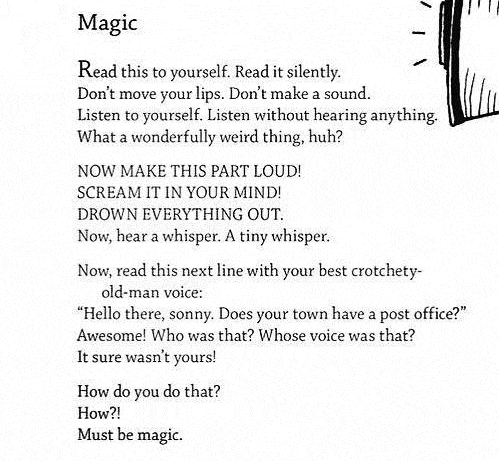


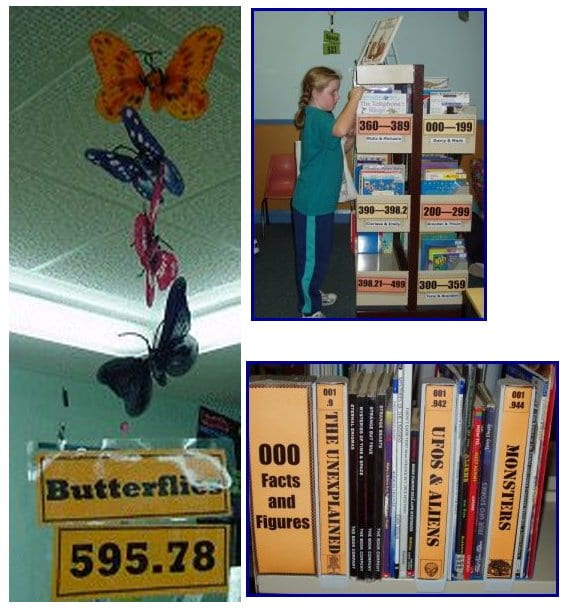
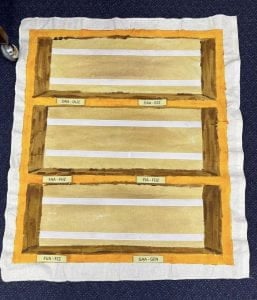
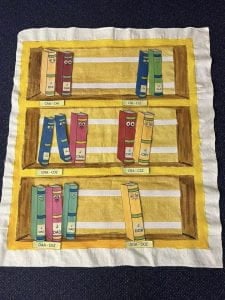

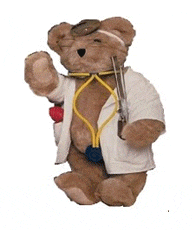


 What does your first week of “library lessons” look like?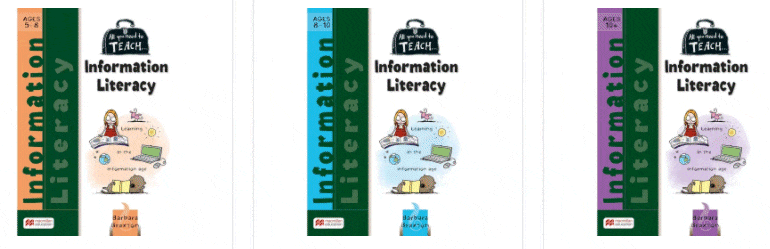



 Your TL degree is so new and shiny that the dust hasn’t had time to settle on its frame yet, but in a few short weeks you are going to be stepping into your dream job – the one you’ve been thinking of for years and have undertaken hundreds of hours of gruelling study to achieve.